Monday, May 21, 2012

Just so you know, "annulus" means "ring"

Hello, fellow Earthicans,

On the evening of May 20, 2012, some lucky sky searchers got to see a relatively rare event - an annular solar eclipse.  In my searching for how to explain to my dear mother why this wasn't a "total solar eclipse" I found this site which does an amazing job, so I will not delve into any such explanations here.

Suffice to say, I was ridiculously excited to see this event.  First of all, before this eclipse I'd never even heard of an annular eclipse...well, ok, maybe I'd heard of it, but it definitely didn't sink into my brain.  Secondly, I never thought I'd get to see a solar eclipse, because I (clearly erroneously) thought that they would only be visible near the equator, and as such, I doubted I'd ever live so close to the path of one.

So on May 20, giddy with excitement and accompanied by my dear boyfriend, I packed up my eclipse glasses, picnic blanket, and camera, and drove about 2 hours north.  I didn't have any plans other than to just drive into the path of annularity, and then find a nice spot to plop down and watch.  We found a lovely place called The Olive Pit in Corning, CA, where, among their many other offerings, they have tastings of olives, olive oils, balsamic vinegars, some cheese, craft beer, and wine - it was pretty much heaven. Check it out if you're ever in the area!

Annular eclipse - almost there!
I took this photo during the eclipse on Sunday, May 20, 2012. It was the best I could do with my super high-tech equipment: a pair of eclipse glasses (which look just like those cardboard 3D glasses) and my trusty Canon Powershot SD 630.

What a pleasant way to spend an evening.  If you ever get the chance to see a solar eclipse, I highly recommend that you do.  Should you choose to take this advice someday, try to remember to get hold of some better equipment than I had.  However, if you just want to watch and not take pictures, don't forget that you should never look directly at the sun, even during an eclipse.

Keep looking up! (just not at the sun) :)

Ms. Disarray

Thursday, April 26, 2012

Hiatus

Hello friends,

I have decided that I need to do a bit of soul-searching, as well as a bunch of writing so I have a stockpile of posts to pick from when I want to publish.  Unfortunately, due to the job hunt, the end of school, and the possibility of moving across the country looming in my future, I just don't have the time to do all the writing necessary to post weekly.

Never fear, though, I will not give up on this blog!  Even though Ms. Disarray is still quite new, I have had a ton of fun with it, and will definitely come back at a later date.  And if I have something to say that I desperately want to say immediately, of course I'll post it!

Send good vibes my way, dear ones! :)

Cheers,

Desiree' / Ms. Disarray

Tuesday, April 17, 2012

Transferring life between planets...but not the way you'e thinking

So, we all know the story:  Millions and millions and millions of years ago, Earth was ruled by these crazily huge lizards until only millions of years ago (65 million, to be precise), when they were mysteriously wiped out completely.  It turns out that recently, scientists have made this mass disappearance a bit less mysterious.

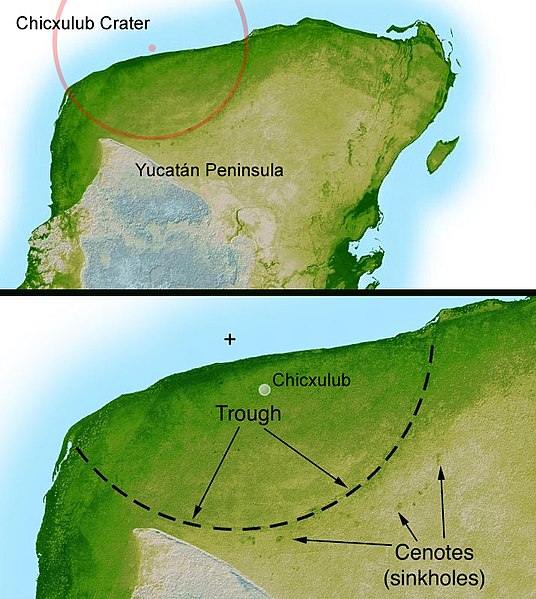
I present, for your amazement, the Chicxulub Crater in Mexico.

Image courtesy of Wikipedia


It is HUGE.  The explosion caused by the 6-mile-wide meteor was equal to about 96 million megatons of TNT, causing what we call an extinction-level event.  This was 65 million years ago.  Coincidence?  I think not.

In a nutshell, there you have it: we have "solved" the mystery of the disappearance of the dinosaurs (I say "solved" because scientists are not 100% certain about this, but it's pretty close to 100%, so I'm happy with that.  If something proves them wrong later, that's ok too!  It's how science works, and that's why I like it.).

For reference, pictured below is the Barringer Meteor Crater in Arizona. It is about a mile across, formed by a meteor that was itself 162 feet across, weighing 330,000 tons, and traveling about 28,600 mph (almost 22,000 times the speed of sound, or Mach 22,000).  The energy released from this impact was equal to about 10 megatons of TNT.  (Check out some other cool examples of what TNT can do here, but also, just for kicks: a supernova, the explosion of a star, is equal to about 10^28, which is a 1 with 28 zeros after it, or 10 octillion, megatons of TNT.)

My point is this: the meteor which struck the Earth 65 million years ago, killing all the dinosaurs, likely also ejected pieces of the Earth into space.

So what, right?

Actually, according to a recent paper** titled, "Transfer of Life-Bearing Meteorites from Earth to Other Planets," that stuff ejected from Earth could have had live material on it.  And if that live material survived, and if it reached another planet...well, you can see where this is going.

In circles discussing the origin of life on Earth, we often hear discussions about life-bearing comets and meteorites "seeding" our lonely planet with the amino acids necessary for life to begin.  This study rocked my world with the idea that Earth could have been just such an origin of life for some other planet.  The paper even examines the possibility of a comet picking up some smaller fragments and carrying them out into interstellar space.

Of course, what discussion of the origins of life would be complete without a speculation of how life could have originated on Earth?  I'll leave you with this quote from the paper's abstract: "...it could be estimated that, if life has originated 10 billion years ago anywhere in our Galaxy...it will have since propagated throughout our Galaxy and could have arrived on Earth by 4.6 billion years ago."  That figure just happens to be about the age of our Solar System.

Okay, I lied.  I'll leave you with this cute comic:

Courtesy of this guy on Twitter


** It has been pointed out to me that this paper is not in the most reliable of journals.  Take everything you read with a grain of salt...or sometimes an entire salt-lick.  In such cases, perhaps it's best to consider such musings as just that: musings.